

The Department of Health and Aged Care published its second quarterly wait times report, covering the period 1 April to 30 June 2026. Now we have state, region and service-level data broken down which gives us an accurate picture of what Support at Home participants are actually facing in reality.The document can be accessed from this link.
Important context
The report uses the term “elapsed time” deliberately to reflect the elapsed number of days from My Aged Care application date to service commencement date recorded by the provider. Time from application to allocation is generally managed by the department, however time between allocation to service commencement may be influenced by individual choice, provider availability and system-level factors.
The national median elapsed time from application to service commencement was 255 days. New South Wales recorded a median of 262 days and this is above the national median and second only to Queensland at 266 days.
The median elapsed time by Sydney regions
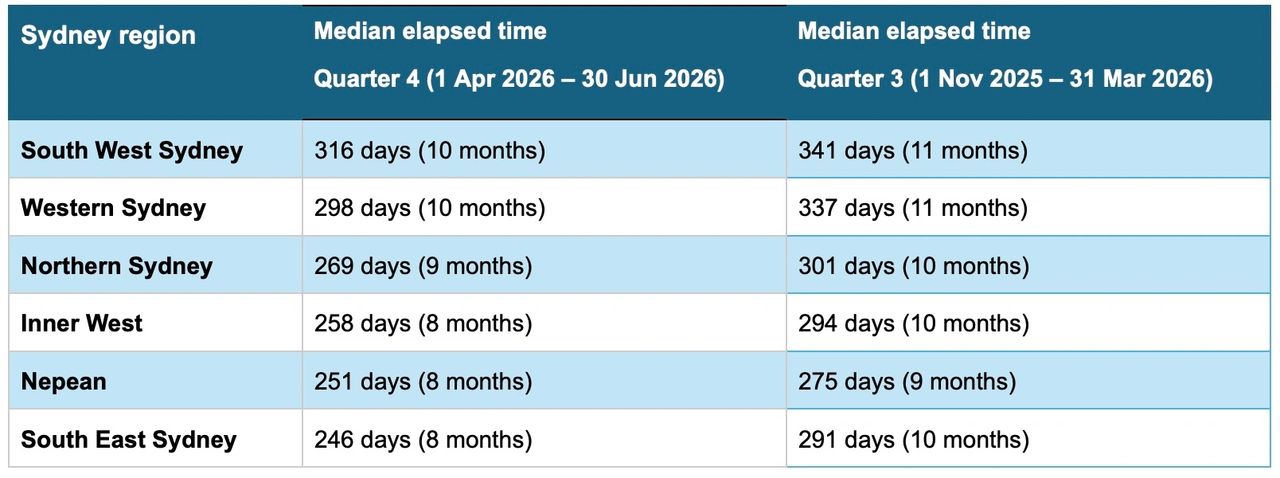
What this means: if a participant in South West Sydney or Western Sydney applied for Support at Home services today, the median elapsed time to service commencement would be approximately 10 months. That is not a worst-case estimate. It is the midpoint, meaning half of participants are waiting longer than 10 months.
The median elapsed time by service types
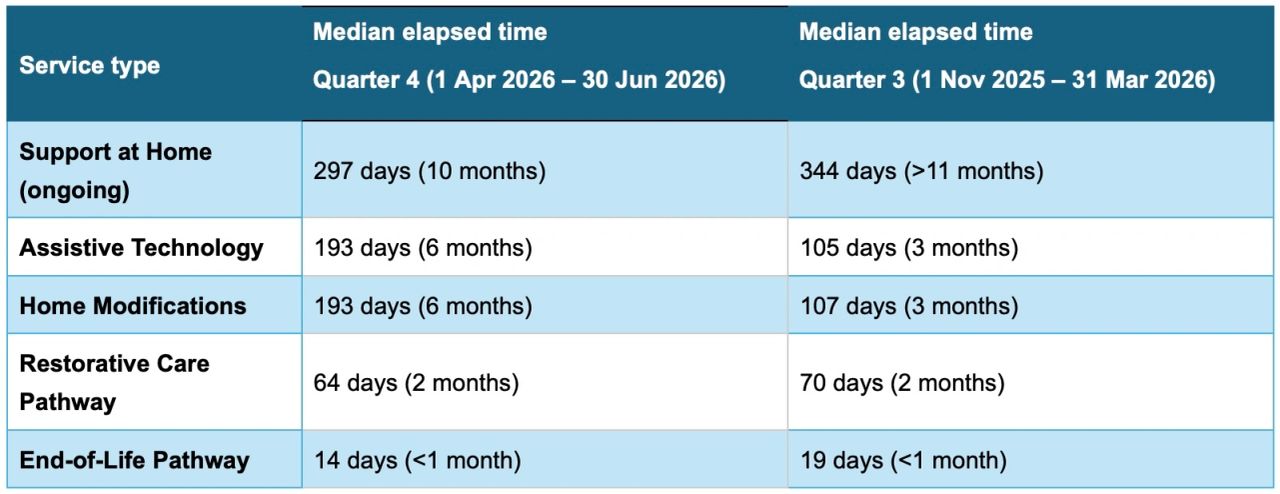
What this means: access to urgent and time-limited pathways is broadly operating in line with policy intent, while ongoing Support at Home services continue to have substantially longer elapsed times. The gap has significant practical implications for participants who are in the queue for the Support at Home allocation.
Three things you can consider differently
1. Start using AT-HM as the primary access point, not as an afterthought
The data shows AT-HM median elapsed time at approximately 6 months, against 10 months for ongoing services in South West Sydney. For any participant in South West Sydney or Western Sydney who has been approved but is waiting for ongoing funding, the first call should not be “when does the funding arrive?” It should be “has AT-HM funding been allocated, and if so, why has an OT assessment not been arranged yet?”
In our experience, the most common answer to that second question is that the care partner was waiting for the ongoing funding to arrive before thinking about allied health. Under Support at Home, with AT-HM running on a completely separate priority track, it is leaving usable funding sitting idle while participants wait in homes that have not been assessed. We have a blog on this topic that you can read it here.
2. The elapsed time data includes time that is partly within your control
The report is careful to distinguish between system-managed wait time and the time from allocation to service commencement, which is influenced by provider availability, consumer decision-making, and how quickly service agreements are finalised.
What the report does not say, but what the data implies, is that in high-demand regions like South West Sydney and Western Sydney, provider availability is a real constraint. Participants are being allocated funding but then waiting weeks or months to find a provider with capacity, negotiate a service agreement, and commence services. It is a service access problem.
3. The Restorative Care Pathway at 64 days median
A 64-day median elapsed time against 316 days for ongoing services in South West Sydney represents a 252-day difference in access to allied health. In fact, the Restorative Care Pathway has its own funding pool and its own priority track, with none of the congestion of the ongoing services queue.
The eligibility criteria for the Restorative Care Pathway are broader than most providers realise. Post-hospitalisation is the obvious trigger, but the pathway is also appropriate for participants with a clear, time-limited rehabilitation goal following any significant functional decline, for example, falls without hospitalisation, deconditioning following illness, and carers not coping at home.
In South West Sydney and Western Sydney, where the typical participant is waiting 10 months for ongoing services, any participant with a rehabilitation goal who could plausibly meet the Restorative Care Pathway criteria should be considered for that pathway first.
What this means for how you work with Super Rehab
In South West Sydney and Western Sydney specifically, where provider capacity is the constraint, that matters. We currently have allied health capacity in both regions and can accept AT-HM referrals and Restorative Care Pathway referrals now. We can arrange a first visit within the first couple of weeks upon receiving a completed referral.
If you have participants sitting in the South West Sydney or Western Sydney queue with AT-HM funding allocated and no allied health assessment underway, that is the conversation we want to have with you, because the data now shows exactly how long those participants are going to be waiting, and an OT assessment arranged today will almost certainly be completed before their ongoing funding is even allocated.